How to learn a song by ear, a phrase at a time
Learning by ear goes faster when you can hear your part on its own, take it a phrase at a time, and climb the speed only when it is easy. Pitband’s Learn mode is built around exactly that, with the written part beside you to check what you hear.
The method
Players who learn quickly by ear tend to do the same few things:
- Hear the whole song first. Know where the verses, choruses and the bridge are before you play a note.
- Hear your part on its own. It is hard to learn a bass line you can only half hear.
- Work in short phrases. Two or four bars at a time, then join them.
- Start slow, climb in steps. A speed you can play cleanly, then a little faster.
- Check what you hear. Compare your playing with the record, and with the written part when you’re unsure.
How Learn does it
Pick your instrument and Learn makes a plan from the song itself: one lesson for each distinct part, in the order they first appear. A chorus you have already learned isn’t taught again; later repeats are folded into it. The plan ends with the whole song, start to finish.
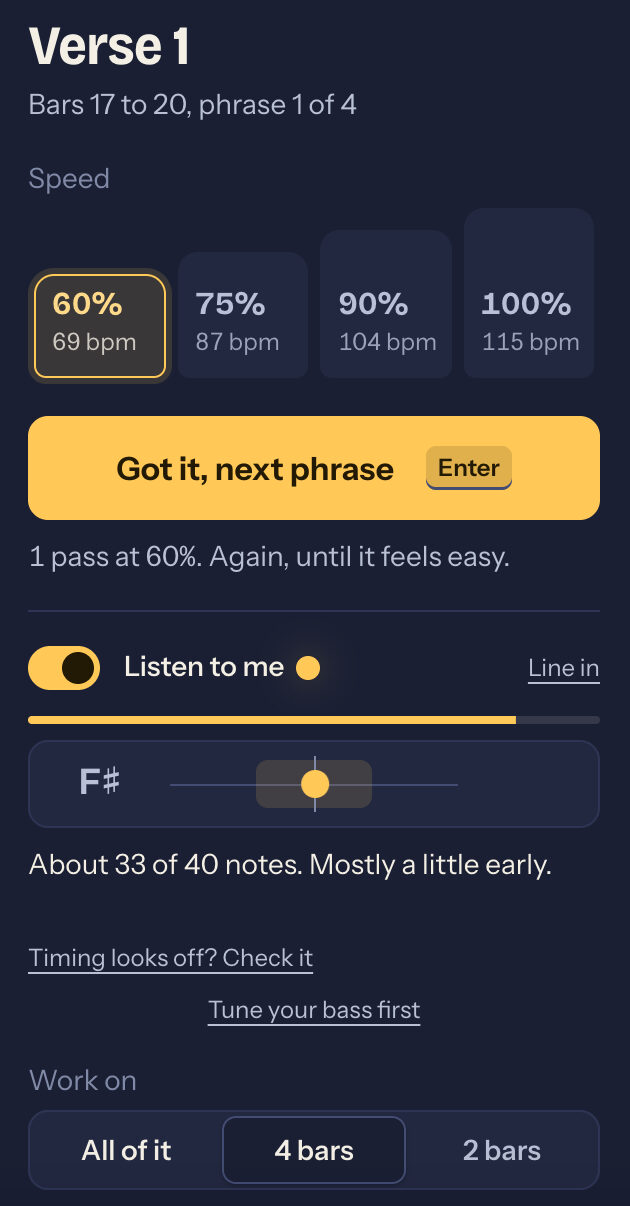
Each lesson loops and climbs a speed ladder: 60%, 75%, 90%, then 100%. Inside a lesson you choose what to work on (all of it, 4 bars or 2 bars) and what to hear:
- Listen: your instrument in front, the band turned down;
- Play along: your instrument silent, so you play it;
- Full band: the record as it is.
When a phrase feels easy, press “Got it” (or Enter). Learn moves to the next phrase, then joins the phrases, then takes you up a speed, until the part is learned. Your progress is saved with the song for each instrument, so you can stop anywhere and come back.
Feedback on every pass
Switch on Listen to me and Learn hears you through a microphone, an audio interface or a MIDI instrument. After each pass it says how it went in a sentence, such as how many of the notes landed and whether you were a little early or late. Two good passes at a speed and it suggests moving up; you still decide. More in practising with feedback.
The written part is there when your ear needs it
Learn shows your instrument’s own view next to the practice panel: the chord shapes and tab for guitar, the falling notes for piano, the bass line, the drum grid, or the vocal line over the words. Use your ears first, and look when you are stuck. Because the transcription is automatic, it is a strong first draft rather than gospel; when your ear and the chart disagree, trust the record.
Then play it
When the parts are learned, Footlights turns the song into a play-along game: Rehearsals build stages from the song’s sections on easy, medium and hard, each ending in the whole song.
Questions
Does Learn work for singers?
Yes. Choose vocals and it teaches the melody phrase by phrase, with the tune traced over the words. With a microphone it tells you how much of the line you sang in tune, and whether you lean sharp or flat.
Do I need to read music?
No. Every part has a view that doesn’t need notation: chord shapes, tab, falling notes, the drum grid or the pitch line over the lyrics. Notation is there if you want it.
Updated .